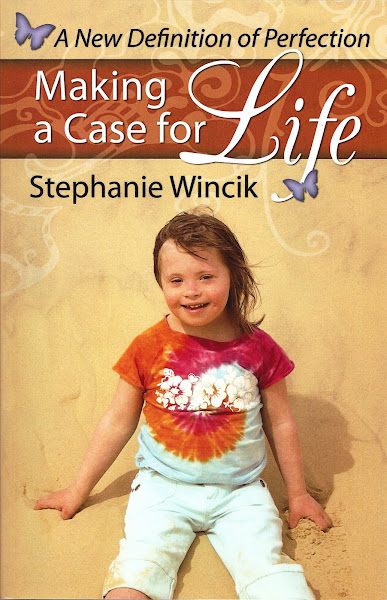

A hideous story out of Italy this past week has once again brought to light the disturbing but nonetheless widely-held notion that disabled children have no intrinsic right to life. Kurt Kondrich, a tireless advocate for the rights of disabled children, has written a powerful response to the tragedy in Italy.
"A baby boy abandoned by doctors to die after a botched abortion was found alive nearly a day later. The mother, pregnant for the first time, had opted for an abortion after prenatal scans suggested that her baby was disabled."
(Ironically, as it turns out, the only "disability" the child was expected to have was a cleft lip and palate, both easily correctable conditions.)
You can read Kurt's full article at the link below:
http://www.renewamerica.com/article/100430
Saturday, May 1, 2010


Sunday, April 25, 2010
Sunday, April 18, 2010
What Does "Pro-Life" Mean Anyway?
Over the past several decades, a great deal of political rhetoric has been focused on the often heated debate between those who identify themselves as “pro-life” versus those who embrace a “pro-choice” philosophy. But what does it really mean to be pro-life? Can one choose life in some circumstances but not others? Despite what many believe is a simple black-or-white, for-or-against issue, I for one struggle to decide which side I am on, or if I even need to choose a side.
As a nurse in the field of developmental disabilities, over the years I have cared for countless children and adults who were born “imperfect” by society’s standards. Until relatively recently, the typical advice for parents who produced a disabled child was to simply institutionalize the baby and “try again,” since the child was unlikely to survive longer than a few weeks or months anyway. Contrary to these dire predictions, however, many such children grew to adulthood despite their overwhelming physical and cognitive impairments.
I have often wondered, as a medical professional caring for these children, if perhaps we have done them a disservice by prolonging their lives. Particularly for those who are non-verbal, how can we know for sure that if given the choice, they would choose life for themselves? Or, if faced with the prospect of life in an institution, constantly undergoing painful medical procedures and hospitalizations designed simply to keep them alive, would they rather their parents had instead chosen abortion and thus spared them from a life filled with indignities? On the other hand, is it possible that these individuals are happy with their lives despite the hardships? Certainly many non-disabled people suffer serious, often prolonged, illnesses during their lifetime and still consider life well worth the trouble.
The answer, of course, is that nobody knows the answer, and this uncertainty is precisely why I find it impossible to take a firm position on either side of the abortion issue. However, if forced to make a choice, I would tend to opt for life in nearly all situations, and the reason is simple—nature has been in the business of selective abortion since the beginning of time, an advantage that trumps our meager experience as humans any day of the week. Children who are not meant to be born, won’t be—the naturally occurring process of miscarriage makes that decision for us.
If a child makes it into the world, then lacking any valid means to make a judgment call ourselves, I believe we must assume that he or she arrived here for a reason, even if our limited vision does not allow us to see it from where we currently sit.
Saturday, April 10, 2010
This past March 21 marked World Down Syndrome Day, an annual global event celebrating the contributions of a unique group of individuals who happened to arrive on earth with an extra chromosome. Unquestionably, people with Down syndrome make the world a better place. But if the current trend continues, fewer of us may have the opportunity to discover this for ourselves, because the Down syndrome population is being exterminated—an estimated 90% of babies expected to be born with Down syndrome are aborted.
So why is that a problem? Aren’t we really doing everyone a favor by sparing parents the heartache of producing a disabled child, as well as saving society the financial burden of supporting someone who may never even hold a job?
Ask Kurt and Margie Kondrich of Pittsburgh, whose daughter Chloe, 6, was born with Down syndrome. Chloe enjoys the life of a typical six-year-old—she attends first grade at her neighborhood school, argues with her brother, goes to birthday parties, and loves the beach. But when two of the children living next door to the Kondrichs were diagnosed with the same progressive, fatal disease, Chloe responded in a manner far beyond her years. “Chloe’s interactions with our five-year-old neighbor and his two-year-old brother are something that is not of this world,” her father says. “Her absolute unconditional love is a model for all of us…she rushes to this family who are in the darkest valley anyone could experience.”
In recent decades, life expectancy for people with Down syndrome has skyrocketed from nine years of age to roughly 60-65. But even as improved medical care is allowing people with Down syndrome to enjoy full, productive lives, 9 out of 10 Down syndrome pregnancies are terminated as a result of advanced prenatal testing methods.
Why? Because prospective parents often lack complete, accurate information about the quality of life now enjoyed by these individuals. Misconceptions about people with intellectual disabilities remain deeply ingrained in our society, particular the notion that being born with a disability is a tragedy. Contrary to this widely-held belief, studies indicate that the vast majority of families living with a person who has Down syndrome view the experience as a decidedly positive aspect of their lives.
Although a great many physicians believe that terminating fetuses with Down syndrome will result in the best outcome for all concerned, their advice is often based on outdated information or is simply the result of minimal experience and familiarity with disabled children and adults. It is this lack of personal experience, coupled with the scientific community’s giddiness over its ability to identify so-called disabilities in the womb, that has led to this silent eugenics movement.
Each year, an increasing number of individuals with Down syndrome are entering the workforce, paying taxes, and volunteering in their communities. Many are finding success as dancers, poets, actors, and filmmakers. But the most powerful impact made by persons with Down syndrome on those around them is achieved through the simple act of being themselves.
As our culture becomes ever more self-absorbed and materialistic, I believe we need more people with Down syndrome, not fewer. If we wish to reverse what appears to be a downward spiral for humanity, then tolerance, good humor, kindness, and compassion—qualities found with remarkable consistency in people with Down syndrome—are the very attributes we must hope all of the new human beings entering our world will possess. And I challenge anyone who meets Chloe Kondrich to support any argument suggesting that the world would be a better place if she had never been born.
Sunday, August 30, 2009
The World Needs Down Syndrome
Many may strongly disagree with the title of this post, but before anyone jumps to conclusions please allow me to explain a bit further. In the process of researching my upcoming book on Down syndrome, I have had the opportunity to speak to a number of families living with an individual diagnosed with DS. Perhaps surprisingly, family members of people with Down syndrome consistently describe their supposedly "disabled" child or sibling as being kind, friendly, honest, funny, and intensely concerned with the welfare of others. In my own contact with these individuals I have observed much of the same.
So why do most people believe that Down syndrome is something to be avoided at all costs? I believe the answer is twofold--first, most people don't really know anyone with Down syndrome. Second, throughout our lives we have been culturally conditioned to conform, fit in, be normal, be perfect. Therefore, our natural reaction to someone who appears different from the social norm is a feeling of discomfort, and it is that discomfort within ourselves that then manifests itself as pity for "that poor child." As a result, we come to believe that the solution is to prevent individuals who are different from entering the world in the first place, all the while assuring ourselves that "it's for the best."
The truth is, people with Down syndrome are not miserable. Certainly their lives are not perfect, nobody's is. For the most part, though, these individuals live in the moment. They delight in discovering and enjoying the best in themselves and others every day. Now tell me, why would we want to have fewer people like this in the world?
Tuesday, June 30, 2009
The Up Side of Down Syndrome
OK, so Down Syndrome really has nothing whatsoever to do with quantum physics, ghosts, or any of the other paranormal subjects I am prone to study and write about. Even so, I have begun writing a new book on the topic of Down Syndrome, for a couple of reasons.
First, I recently had the distinct pleasure of welcoming a delightful young lady with Down Syndrome into my home. She quickly became an integral part of our family and is a constant source of good humor, exuberance, and fun. My second reason for starting the book is a bit more serious. While skimming a recently published book on autism a few months ago, I stumbled upon this disturbing statistic: due to the wide availability of new and less invasive prenatal testing, 80-90% of all children with Down Syndrome are being aborted in the first trimester.
Initially I was sure the number had to be an exaggeration, but after further investigation I discovered the statistic was accurate. Largely due to outdated and inaccurate information about Down Syndrome, the majority of physicians are strongly recommending termination of these pregnancies, leaving many parents with what they feel is little choice in the matter. Most of what the general public knows about Down Syndrome is based on stereotypes, misinformation, and a lack of experience relating to individuals with intellectual disabilities. (By the way, the term "mental retardation" is being officially phased out as a medical diagnosis and is being replaced with "intellectual/developmental disability.")
The purpose of the book is to raise awareness of this alarming trend (with which we seem to be teetering dangerously close to the practice of eugenics,) and to dispel the common myths about Down Syndrome. Modern advances in health care are allowing most individuals with Down Syndrome to live longer, more productive lives than ever before. I hope to show that these individuals, once revered by some ancient cultures as being endowed with god-like qualities, are less of a burden on society than a good portion of our so-called "normal" population.
Wednesday, February 4, 2009
More years ago than I care to count, my life was profoundly affected by a low budget, independent student film called Billy Jack. I particularly recall, almost verbatim, the content of a speech made by the main character while he was apparently channeling the spirit of an ancient holy man known as Wovoka. In that instant, I connected with an idea that I suddenly realized had always resonated with me as truth, but that my Protestant religious upbringing had never allowed me to really believe until that moment:
Heaven is not out there. The other world is here.
Your people, my loved ones…there is a thin veil separating us from them.
Finally, an explanation that made sense. The thought of disembodied spirits floating around on clouds in some vague, unseen location in the sky never seemed logical to me. Not only that, but wouldn’t it be boring? I don’t know about you, but I don’t find the thought of “eternal rest” after death especially appealing. The idea that our spirits remain on earth, albeit on a different plane, seems an infinitely more interesting way to spend the afterlife. At least we could find ways to occupy ourselves, even if we need to haunt our loved ones for entertainment!
A thin veil. A curtain that some can see through easily and others cannot. But why? Why do some people, even while vigorously claiming not to believe in them, regularly see ghosts while others do not? That question alone seems intriguing enough to warrant further investigation.
In 2002, when I was researching my first book, Ghosts of Erie County, most of the individuals I interviewed had a great deal of difficulty discussing their experiences out of fear of ridicule. Some said they had only disclosed these experiences to close family members, or perhaps to no one at all. Several of the folks agreed to tell me their stories only if I promised not print their real name, place of business, or any other identifying information.
This reaction is certainly understandable. Historically, those who claim to have had an encounter with the unknown, whether it be ghosts, UFO’s, or any other being not thought to be of the “natural” world, have been met with accusations of insanity, involvement in witchcraft, or just plain weirdness. In reality, however, almost everyone I know has had at least some type of unexplainable experience. And happily, in the six or so years since my first book, I have discovered an exciting trend in the general acceptance of these phenomena. People today are significantly more open about their supernatural experiences. Evidence of this trend can be seen everywhere. On any given evening, you can surf your cable TV channels and find at least half a dozen programs focusing on ghost-hunting, UFO sightings, psychics, or simply “the unexplained.”
In fact, I believe we are on the verge of a universal spiritual renaissance, when those experiences formerly thought to be supernatural will all be found to be part of our natural world. It appears that human beings, especially those in the western world who have been stubbornly resistant to accepting ideas we cannot yet prove scientifically, are finally ready to take a hard look at the possibility that there is an entire unseen world around us just waiting to be discovered.
Subscribe to:
Posts (Atom)